"But as the years passed, as I dealt with hundreds of entrepreneurs, and with Packard himself, I began to understand that the key to the greatness of Bill Hewlett and David Packard was that they held no attachment to things, only people. The garage was left behind, as would be, in time, the redwood building. So too was the audio oscillator and thousands of other products--all abandoned in the endless pursuit of something better. Only the people remained, and they were cherished and respected, far more than by any corporation in history. The Addison garage was left behind because to fetishize it would upset the proper hierarchy of things that mattered in the HP Way."
Stanford Magazine said that Bill and Dave's contribution was as much organizational as technological. "Hewlett, ’34, Engr. ’39, and Packard, ’34, Engr. ’39, were visionaries in creating a corporate culture and management style -- the HP Way -- that could keep pace with the ever-accelerating evolution of the electronics industry. They came up with an approach that respected personal autonomy and stressed corporate decentralization. They systematically nurtured employee satisfaction and morale, which led to a steady stream of leading-edge, highly profitable products."
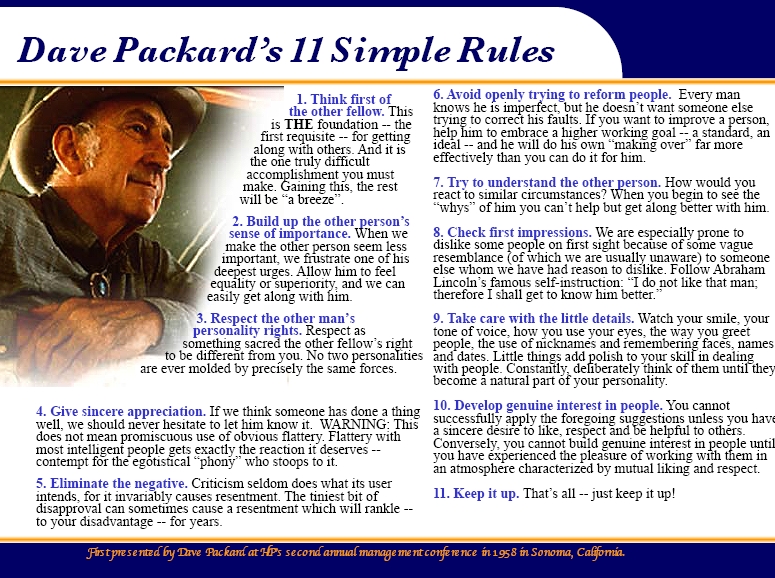
Bill Hewlett's "Human Side of Management" and Dave Packard's "11 Simple Rules" are important. As Forbes Magazine said, "They held no attachment to things, only people."
But the company that Bill and Dave built and managed did indeed have a reputation in 1992 for great products. And Corvallis played a big role in the company in the years leading to 1992 and beyond. I'll write later about inkjet printing, but it's also important to know that one of the most famous HP products, the HP 12-C, was invented in Corvallis.
Here is a historical summary of HP in "the Bill and Dave years" from Reuters and Fox:
1939: Stanford electrical engineers Bill Hewlett and Dave Packard found the company out of a Palo Alto garage with $538 and a Sears-Roebuck drill press. They decide whose name would go first with a coin toss.Revenue is $5,369 after one year. Their first product is the resistance-capacitance audio oscillator, a version of which was sold to the Walt Disney Co.
1940: HP pays its first bonus to employees -- a $5 Christmas windfall. In the 1940s, it begins to benefit from U.S. orders for electronics with the onset of World War Two and growing acceptance for its products in the engineering and scientific community. Revenues at year-end total $34,396.
1942: Construction kicks off on the company's first building, in Palo Alto. The 10,000-square-foot office, laboratory and factory -- with an open floor plan -- is designed to be easily converted into a grocery store should the business fail to grow. Revenue hits $522,803.
1947: HP is incorporated. Packard is named President, and Hewlett is named Vice President.
1948: Revenue surpasses the seven-figure mark, ending the year at $2.2 million from 128 employees.
1957: HP becomes a publicly traded company with an initial public offering of $16 per share. Revenue is $28 million this year.
1958: HP makes its first acquisition: of graphic recorder maker F.L. Moseley Co of Pasadena, California.
1962: For the first time, HP makes Fortune Magazine's top 500 U.S. companies, ranking 460.
1964: Packard is elected CEO and chairman of the board. Hewlett is named president.
1966: HP develops its first computer, the HP 2116A, making its entry into that business.
1968: HP introduces the world's first desktop scientific calculator that stores programs on magnetic cards. Advertisements for the device call it a "personal computer," one of the first uses of the term.
1972: HP introduces the HP-35, the first scientific handheld calculator.
1977: Hewlett retires as president but remains CEO. Packard remains chairman. HP engineer John Young is named president.
1978: Hewlett retires as CEO and the company names Young to succeed him. Young serves until 1992.
1980: HP introduces its first personal computer, the HP-85 and a steady stream of PCs follow.
1981: HP introduces the "Voyager" series of handheld calculators. This includes the HP 12-C, HP's longest and best-selling product, in continual production since its introduction. The Voyager series was invented and designed in Corvallis.
1984: HP debuts its LaserJet printer, the company's most successful product line ever. HP also introduces the ThinkJet thermal inkjet printer using technology first developed five years earlier in 1979. HP also transitions from the HP3000 to the HP9000 series minicomputers with attached storage such as the HP 7935 hard drive holding 404 MB.
1986: On March 3, 1986, HP registers the HP.com domain name, making it the ninth Internet .com domain ever to be registered.
1987: The Palo Alto garage where Bill and Dave started HP was designated as a California State historical landmark and is named "the birthplace of Silicon Valley."
1989: HP turns 50. HP buys Apollo Computer. HP's annual revenue has grown to $11.9 billion, employees total 95,000.
Early 1990s: HP expands their computer product line, which initially had been targeted at university, research, and business users, to reach consumers.Another good history of HP is found in the Wall Street Journal.
In 1978, when Bill Hewlett retired and John Young became CEO, I didn't really know much about HP. The HP that I have known was the one that John Young guided following Bill and Dave's model. The HP Way was key to John Young's leadership, but HP old-timers already saw changes following Bill and Dave's departure from active involvement in the company.
Next: HP History: 1992-1999 - The Lew Platt Years

No comments:
Post a Comment